Tools Used
-
WATCHOUT Media Server
-
Elgato Stream Deck
-
Adobe After Effects
-
Blender
Scope
-
Projection system installation
-
Multi-projector calibration & mapping
-
Stream Deck cue programming
-
Operator training & documentation
Project Overview
Project Brief
An abstract and elegant perspective of friendship through seasonal, scenic transitions in PlayMakers Repertory Company's production of Steel Magnolias. Notice how relationships evolve in each season of life by catching glimpses of the performer's silhouettes across the projected backdrop.
Audiences arrived at the salon with Truvy, Annelle Shelby, M'Lynn, Ouiser and Clairee to experience how supportive friendships grow connections through hardships and conversation.

Christmas season projection transition with silhouettes of performers. Photo by HuthPhoto
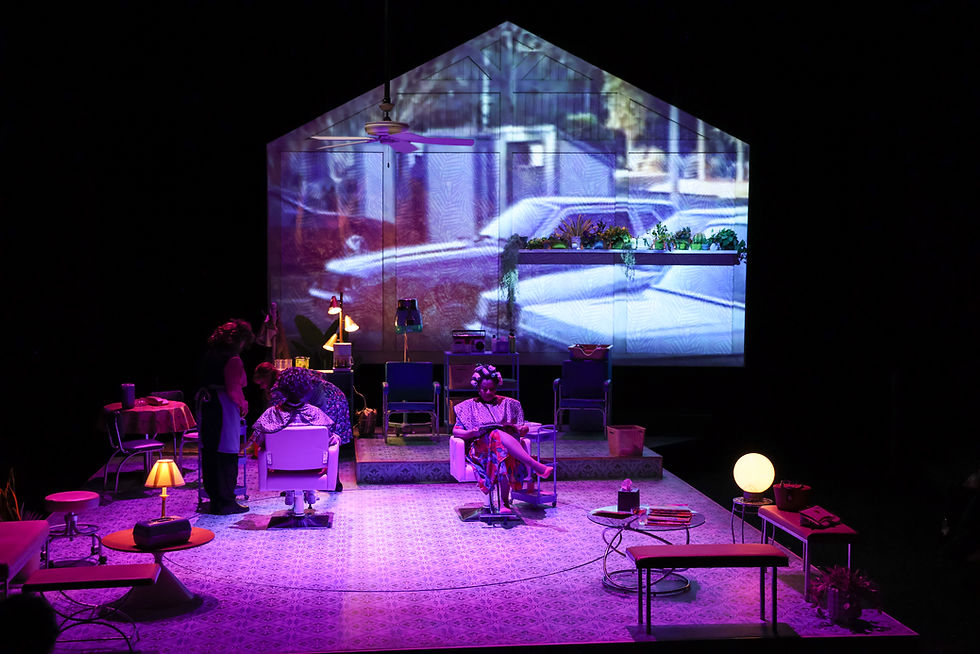
Archival photo of spring season transition. Photo by HuthPhoto

Summer season projection transition. Photo by HuthPhoto
Christmas season projection transition with silhouettes of performers. Photo by HuthPhoto
My Role
The journey from design to performance began on paper. Working from Projection Designer Tao Wang's CAD ground plans, sectional drawings and system diagrams, I translated a precise technical vision into a physical reality, rigging two projectors into the theater grid, running Cat 6 cabling throughout the system and installing WATCHOUT media servers to bring the network to life.
Once the hardware was in place, the creative work began. I corrected keystone distortion and mapped both projectors until two separate beams read as one continuous world. Alongside Wang, I built original motion graphics in Adobe After Effects and Blender, layering them against personal home videos contributed by the production team until the footage stopped feeling like footage and started feeling like memory.
The final step was handing the system to someone else. I programmed an Elgato Stream Deck as a unified control dashboard, collapsing a complex multi-system rig into single-button simplicity. I trained the operator, then wrote a production Run Book so the show could live on without any designer in the room.


Challenges
The design lived in the tension between two projectors that needed to feel like one.
The top-grid projector held the world together, keeping imagery across the full backdrop at all times. The second, positioned in the vom, had a different job: it cast light directly onto performers during scenic transitions, absorbing their silhouettes into the media and creating the impression that the performers onstage and the lives onscreen existed in the same moment. Getting both units to feel unified required deliberate perspective alignment so the audience never registered the mechanics, only the emotion.
The archival footage carried its own weight. The people in the videos were not the performers, but they represented them across a lifetime of ordinary moments, birthdays, bike rides, graduations. Weaving that material with original graphics until it read as impressionistic rather than assembled took time and instinct in equal measure. The style was never explicitly requested. It emerged from living inside the footage long enough to understand what it wanted to be.
The Result
When the scenic transitions came, audiences had somewhere to look.
The projection drew their eyes upward and inward, into footage that felt familiar even when it wasn't. The silhouettes of the performers moving through that light gave the transitions an emotional weight they might otherwise have lacked, a poetic pause between scenes that left the story resonating before the next one began.
The Stream Deck system, built from Wang's research into networked theatrical control, proved that emotional precision and operational simplicity are not competing goals. The world it created felt anything but simple.
All media content presented in this portfolio is used solely for the purpose of professional documentation and creative portfolio representation. Original motion graphics and projection designs are the creative work of Tao Wang, Grant Sizemore and Luna Hayes. Archival footage was contributed by members of the PlayMakers Repertory Company production team and used with permission. All rights to Steel Magnolias as a dramatic work remain with Robert Harling. PlayMakers Repertory Company retains all rights to this production.